New Jersey Truck Accident Lawyer

Over $100M Recovered

Get a FREE case evaluation today

John Onal Super Lawyer Award badge

We Fight to Get You the Maximum Compensation

got hurt? get onal.

Verdicts & Settlements*

Our team is relentless in pursuing justice and compensation for our clients, using our expertise to deliver exceptional results.

$17.895M

Bus Accident

$5.00M

Brain Injury

$3.35M

Brain Injury

$2.50M

Medical Malpractice

A New Jersey truck accident lawyer at Onal Injury Law represents individuals and families who have suffered serious injuries in collisions involving tractor-trailers, 18-wheelers, and other commercial vehicles on the state's highways. 

Truck accident claims are evidence races. Electronic logging data, event data recorder (black box) information, dashcam footage, and dispatch records may be overwritten or lost within days of the crash if not preserved through immediate legal action. At Onal Injury Law, our attorneys handle serious truck accident cases across New Jersey with the preparation and urgency these claims demand.

If you or a family member were seriously injured in a truck collision, call our team at 1-800-LAW-GOATS to discuss your case. Our attorneys provide a free initial consultation and outline the next steps based on the specific facts of your situation.

Why Choose Onal Injury Law’s New Jersey Truck Accident Attorneys

Truck accident litigation requires a different level of preparation than a standard auto collision case. Trucking companies and their insurers deploy rapid response teams within hours of a serious crash, often before the injured person has left the hospital. Our approach is built to meet that pace.

  • Immediate evidence preservation: We issue spoliation letters to the trucking company, broker, and maintenance providers to prevent the destruction of ELD data, dashcam footage, inspection logs, and dispatch records. ECM data may be overwritten if not secured promptly.
  • Multi-party liability analysis: Truck accident claims often involve the driver, the motor carrier, the vehicle manufacturer, the cargo loader, the maintenance contractor, and, in some cases, the freight broker. We analyze the evidence to determine the liable parties.
  • Trial-ready preparation from day one: Every case we accept is built as though a jury will hear it. That standard of preparation strengthens settlement negotiations and protects the client's position throughout the process.
  • Clear communication and accountability: Our clients know who is handling their case, what stage it is in, and what to expect next. A single point of ownership means questions get answered, not routed.

Serious injuries demand more than representation. They demand a higher standard.

Onal Gallant New Jersey law firm. Personal Injury.

The Scale of Truck Accidents on New Jersey Roads

New Jersey's position along the I-95 corridor, the New Jersey Turnpike, the Garden State Parkway, and major freight routes like I-78, I-80, and I-287 places the state at the center of East Coast commercial trucking. The volume of truck traffic through the state creates a significant collision risk.

Nationally, 5,472 people were killed, and an estimated 153,452 people were injured in traffic crashes involving large trucks in 2023, according to NHTSA data. While the number of large trucks involved in fatal crashes decreased by 8.4% from 2022, it remains 43% higher than the last decade. Large trucks accounted for 9% of all vehicles involved in fatal traffic crashes, but only 5% of all registered vehicles.

How Does New Jersey's No-Fault System Apply to Truck Accident Claims?

New Jersey operates under a no-fault insurance framework. After any motor vehicle collision, each person typically turns to their own Personal Injury Protection (PIP) insurance for medical expenses and certain financial losses, regardless of fault. PIP activates immediately and covers medical treatment, a portion of lost income, and essential services during recovery.

However, PIP addresses only a limited category of economic losses with defined caps. Pursuing compensation beyond PIP, including pain and suffering, long-term earning capacity losses, and other non-economic damages, may require meeting the serious injury threshold under N.J.S.A. 39:6A-8, depending on the tort option selected. 

If the policyholder selected the verbal threshold (limitation on lawsuit), non-economic damages are available only when the injury qualifies under one of six statutory categories: 

  • Death
  • Dismemberment
  • Significant disfigurement or scarring
  • Displaced fractures
  • Loss of a fetus
  • Permanent injury that has not healed to normal function and will not heal with further treatment

If the policy carries the zero threshold (no limitation on lawsuit), non-economic damages are available regardless of injury type.

Practice Areas

Car accident

Truck accident

Slip and Fall

Refinery accidents


Medical malpractive

Bicycle accident

Medical malpractice

Bicycle accident

Nursing home

abuse

Traumatic brain

injury


Wrongful death

Workers' compensation

Wrongful death

Workers' compensation

Federal Regulations That Can Impact a New Jersey Truck Crash Case

Commercial trucking is governed by federal regulations enforced by the Federal Motor Carrier Safety Administration (FMCSA). Violations of these regulations often form the basis of a negligence claim against the driver, the motor carrier, or both.

Hours of Service Rules and Driver Fatigue

FMCSA hours of service (HOS) regulations limit how long a commercial driver may operate before taking mandatory rest. Property-carrying drivers are generally limited to 11 hours of driving within a 14-hour on-duty window after 10 consecutive hours off duty. Carriers that pressure drivers to exceed these limits, falsify logs, or incentivize longer hours may bear direct liability for fatigue-related crashes.

Electronic Logging Devices and the Evidence They Contain

Since 2017, FMCSA has required most commercial motor vehicles to use electronic logging devices (ELDs) to record driving time. ELD data may reveal HOS violations, irregular duty cycles, and patterns of fatigue that paper logs once concealed. This data may be overwritten if not preserved quickly, making early spoliation letters to the motor carrier critical.

CDL Requirements and Driver Qualification

Drivers of commercial vehicles over 26,001 pounds must hold a Commercial Driver's License (CDL). FMCSA requires carriers to maintain driver qualification files documenting license status, medical certification, employment history, and prior safety violations. When a carrier fails to verify qualifications or hires a driver with a disqualifying safety record, a negligent hiring or negligent supervision claim may apply.

Other Federal Standards That May Apply

Beyond HOS, ELD, and CDL requirements, FMCSA regulations touch nearly every aspect of commercial trucking operations. Additional areas that frequently factor into truck accident claims include:

  • Vehicle inspection, repair, and maintenance standards requiring carriers to systematically inspect, repair, and maintain all commercial vehicles under their control
  • Cargo securement rules governing how freight must be loaded, distributed, and restrained to prevent shifting or falling during transport
  • Drug and alcohol testing requirements, including pre-employment, random, post-accident, and reasonable suspicion testing for CDL holders
  • Weight and size limits enforced at the federal and state level, with overweight or oversized loads requiring special permits and creating additional handling risks
  • Insurance and financial responsibility minimums, which require motor carriers to maintain liability coverage appropriate to their operations
  • Post-accident testing protocols that mandate drug and alcohol testing of the driver after crashes meeting certain severity thresholds

Each of these regulatory areas may provide evidence of negligence when a violation contributed to the cause or severity of the crash.

Common Types of Truck Accidents in New Jersey

The type of truck accident affects the injury profile, the liability analysis, and the evidence that matters most.

  • Jackknife accidents occur when a tractor-trailer's drive wheels lock and the trailer swings outward, folding against the cab. These crashes often involve multiple lanes of traffic and may cause chain-reaction collisions.
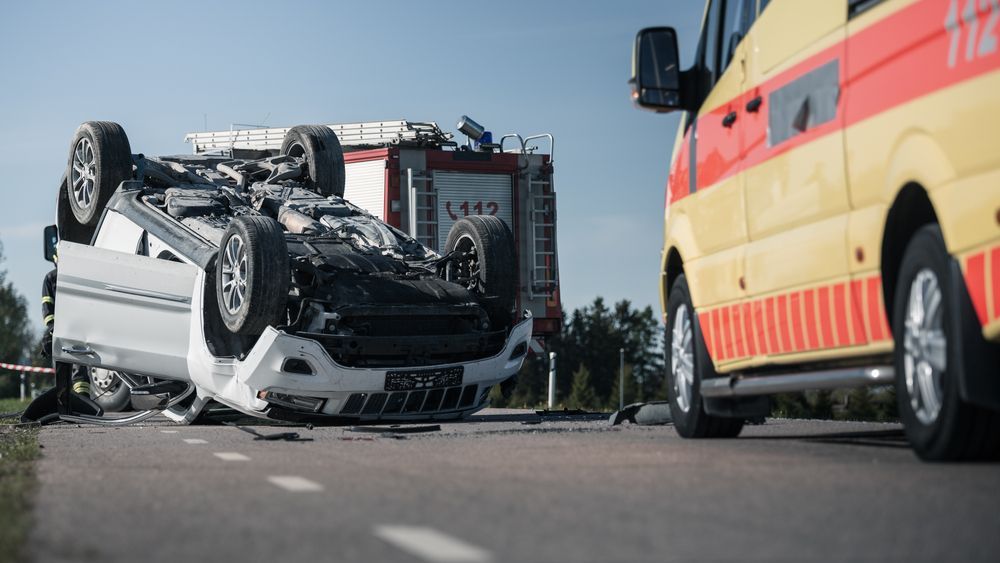
  • Rollover accidents happen when a truck tips onto its side or roof, often due to excessive speed on curves, top-heavy cargo, or sudden steering corrections. Rollovers on highways may scatter cargo across multiple lanes and create extended hazard zones.
  • Underride collisions occur when a smaller vehicle slides beneath the rear or side of a truck trailer. These crashes are among the most catastrophic because the passenger vehicle's safety systems may not engage as designed.
  • Blind spot collisions involve vehicles traveling in the truck's extensive blind zones along both sides, directly behind, and directly in front of the cab. Lane-change and merge-related crashes frequently involve blind spot factors.
  • Wide turn accidents happen when a truck swings left to execute a right turn, creating a gap that adjacent vehicles may enter. The closing space between the trailer and the curb may trap vehicles that moved alongside the truck during the turn.

Each accident type produces distinct damage patterns and involves different categories of evidence. Identifying the type of collision early helps focus the investigation on the evidence most likely to establish fault.

Common Causes That Our Truck Accident Lawyers in New Jersey See

Every truck accident claim begins with identifying the cause. The evidence determines not only what went wrong but who bears responsibility.

Driver Fatigue

Driver fatigue remains one of the most dangerous factors in commercial trucking. Even within HOS limits, a driver who has accumulated sleep debt over multiple days may experience impaired reaction times and decision-making. ELD data, dispatch records, and the driver's trip history over the preceding weeks may reveal patterns of insufficient rest.

Distracted Driving

Cell phone use, GPS programming, and dispatching communications while operating divert the driver's attention from the road. Cell phone records and onboard camera footage may document distraction in the moments before a collision.

Improper Cargo Loading

Unsecured, overloaded, or unevenly distributed cargo affects vehicle stability and stopping distance. These conditions may cause rollovers, jackknife events, or loss of control. The party responsible for loading, whether the shipper, the carrier, or a third-party loading company, may bear liability when cargo-related failures contribute to a crash.

Maintenance Failures

Brake system deficiencies, tire blowouts, steering component failures, and lighting defects often trace back to deferred maintenance, inadequate pre-trip inspections, or cost-cutting by the motor carrier. FMCSA inspection and maintenance records may reveal a pattern of known defects that the carrier failed to address.

What Compensation May Be Available for a New Jersey Truck Accident Injury?

The severity of truck accident injuries often places the full range of damages in play. Recovery may draw from PIP benefits, the at-fault parties' liability coverage, and, in some cases, multiple policies across several defendants.

PIP Benefits

PIP activates immediately after the accident and covers medical expenses, a portion of lost income, and essential services during recovery, regardless of fault. PIP limits depend on the policyholder's coverage selection, ranging from $15,000 on a basic policy to $250,000 on a standard policy.

Economic Damages Beyond PIP

A liability claim against the at-fault parties may recover measurable financial losses that PIP does not fully cover. These include:

  • Past and future medical expenses, including surgery, hospitalization, rehabilitation, and long-term care
  • Lost wages during the recovery period
  • Diminished earning capacity when injuries permanently limit the ability to work
  • Out-of-pocket costs such as transportation to medical appointments, home modifications, adaptive equipment, and attendant care

Life care planning and forensic economic analysis help document the scope of future costs.

Non-Economic Damages

If the injury meets the serious injury threshold under N.J.S.A. 39:6A-8, or if the applicable policy carries the zero threshold, non-economic damages become available. These may include physical pain and ongoing discomfort, emotional distress, loss of enjoyment of life, and loss of consortium.

Wrongful Death and Survival Claims

When a truck accident results in a fatality, surviving family members may pursue a wrongful death claim for lost financial support, household services, and funeral expenses. A separate survival action addresses the pain and suffering the deceased experienced between the time of injury and death. These claims often proceed together and may involve substantial damages given the catastrophic nature of most fatal truck collisions.

Injuries That Demand a New Jersey Truck Injury Attorney

The weight disparity between a fully loaded tractor-trailer (up to 80,000 pounds) and a passenger vehicle (approximately 3,500 pounds) produces injuries far more severe than those in typical car accidents. These injuries may require long-term or lifelong care, and their impact on earning capacity, independence, and quality of life may factor significantly into the damages calculation.

Serious injuries can include: 

  • Traumatic brain injuries (TBI) may result from direct impact, rapid deceleration, or objects penetrating the passenger compartment
  • Spinal cord injuries, including complete and incomplete injuries, may result in partial or total paralysis
  • Amputations and crush injuries occur when the structural integrity of the passenger vehicle is compromised
  • Internal organ damage from blunt force trauma may require emergency surgery and extended hospitalization
  • Multiple fractures, including compound and displaced fractures, frequently require surgical intervention, hardware placement, and rehabilitation 
  • Severe burn injuries may result when fuel systems are breached on impact, often requiring specialized treatment at designated burn centers, multiple surgical procedures, and ongoing care 

The severity of these injuries is what separates truck accident litigation from standard auto collision claims. Documenting the scope of current and future care needs is essential to pursuing compensation that reflects the true cost of the injury.

How it works

Getting started is simple. No charge unless you win

Step 1

Progress icon

Submit
your claim

With a no-cost case assessment, it's simple to submit your case with John Onal.

Step 2

Personal injury injury process

We proceed

Our committed team starts investigating your claim promptly.

Step 3

We fiercely defend your rights.

If we accept your case, our team will vigorously pursue the results you deserve.

FAQs for New Jersey Truck Accident Attorneys

How Much Is My Truck Accident Case Worth in NJ?

The value of a truck accident case depends on the severity of the injuries, the cost of past and future medical treatment, lost income and diminished earning capacity, the degree of pain and suffering, and the number of liable parties and available insurance policies. An attorney may provide a more specific assessment after reviewing the medical records, evidence, and applicable coverage.

Who Can Be Held Liable in a New Jersey Truck Accident?

Liability may extend to the truck driver, the motor carrier, the vehicle or parts manufacturer, the cargo loader or shipper, the maintenance contractor, and, in rare cases, the freight broker. Each party's role in causing or contributing to the accident determines its share of responsibility. Truck accident claims often involve multiple defendants with separate insurance policies.

What Evidence Matters Most in a Truck Accident Case?

ELD data, ECM/black box recordings, driver qualification files, dispatch records, maintenance and inspection logs, dashcam footage, and cell phone records are among the most critical evidence in a truck accident case. Securing this evidence early often determines the strength of the claim.

What if the Trucking Company Says the Driver Was an Independent Contractor?

Motor carriers sometimes classify drivers as independent contractors to limit their exposure to liability. New Jersey courts may look beyond the contractual label to evaluate the actual working relationship, and the carrier may be held vicariously liable. Additionally, FMCSA regulations assign safety responsibilities directly to the motor carrier regardless of the driver's employment classification.

How Long Do I Have to File a Truck Accident Lawsuit? 

New Jersey's statute of limitations for personal injury claims is generally two years from the date of the accident under N.J.S.A. 2A:14-2. Wrongful death claims carry the same two-year deadline, running from the date of death. Claims against government entities, including those involving state or municipal vehicles, require a notice of tort claim within 90 days of the accident.

Will My Truck Accident Case Settle or Go to Trial?

Many truck accident cases resolve through negotiation or settlement, but the outcome depends on the strength of the evidence, the severity of the injuries, and the willingness of the defendants and their insurers to offer fair compensation. Our firm prepares every case as though it will go to trial, strengthening negotiating position and protecting our client’s future interests.

The Case Starts Before You Call

A truck accident claim is already taking shape while you are still in the hospital. The carrier's insurer is dispatching investigators, downloading data, and building a defense. The evidence that may define your case has a limited shelf life, and every day without a preservation demand is a day that critical records may be overwritten or lost.

At Onal Injury Law, we meet that reality with the urgency and discipline it demands. Our attorneys preserve critical evidence on day one, identify every liable party, and build the case with the depth that serious truck accident claims require. 

Call us at 1-800-LAW-GOATS to discuss your case during a free consultation.

Blog

A professional in a suit writes at a desk beside a brass scales of justice and a gold desk lamp.
By john onal March 31, 2026
An NJ hit-and-run car accident can cause injuries, vehicle damage, and no information about the driver who caused it. The other vehicle is gone. There is no license plate, no insurance card, and no one to hold accountable at the scene.
Two cars are severely damaged after a collision, with debris on the road and an orange traffic cone nearby.
By john onal March 31, 2026
If you were an injured passenger in a New Jersey car accident, your medical bills typically go through PIP first, and then you may pursue additional damages depending on the severity of your injuries and the insurance policies involved.
A person wearing a black LS2 motorcycle helmet with a reflective visor, set against a blurred, warm-toned outdoor background.
By john onal March 31, 2026
New Jersey's motorcycle helmet law requires every rider and every passenger to wear a properly fitted, approved helmet on every ride.
A first-person view from a motorcycle handlebars, showing a paved road winding through a wooded landscape.
By john onal March 31, 2026
The injuries motorcyclists suffer most often in New Jersey tend to be more serious than what you'd see in a typical car crash because there's nothing between the rider and the road.
By john onal March 31, 2026
If you were an injured passenger in a New Jersey car accident, your medical bills typically go through PIP first, and then you may pursue additional damages depending on the severity of your injuries and the insurance policies involved. Passenger rights after a car accident in NJ start with a simple fact: passengers are almost never at fault. Unlike drivers, who may share blame under comparative negligence, a passenger had no control over the vehicle's speed, direction, or decision-making. That distinction gives injured passengers a stronger starting position than most other claimants in a New Jersey car accident case. The complication is not fault. It is figuring out which insurance policies apply, in what order, and whether the injuries qualify for compensation beyond what PIP covers. Recovery for an injured passenger may involve their own auto policy, a family member's policy, the driver's policy, the at-fault driver's liability coverage, or a combination of several. Free Consultation – Speak With a Lawyer Now Key Takeaways for Passenger Rights Car Accident NJ Claims Passengers are rarely assigned fault in a car accident, which means New Jersey's modified comparative negligence rule under N.J.S.A. 2A:15-5.1 typically does not reduce a passenger's recovery PIP coverage follows a priority hierarchy: the passenger's own policy pays first, then a resident family member's policy, then the policy on the vehicle the passenger was riding in A passenger may pursue a liability claim against the at-fault driver, even if that driver is a friend or family member, because the driver's insurance usually handles the defense and may pay compensation up to the policy limits The verbal threshold applies to passengers based on the tort option selected on the policy providing PIP, which may limit access to pain and suffering damages unless the injury meets one of six statutory categories under N.J.S.A. 39:6A-8 When multiple drivers share fault for the accident, the passenger may pursue liability claims against each at-fault driver's insurance Whose Insurance Pays First for a Passenger's Injuries in NJ? New Jersey's no-fault system requires each person to turn to their own PIP coverage first after an auto accident, regardless of fault. For passengers, this creates a priority hierarchy that determines which policy provides benefits. PIP coverage in New Jersey follows the person, not the vehicle. For passengers, three levels determine which policy pays first: The passenger's own auto policy . If the passenger owns a car and carries insurance, that policy is the primary source of PIP benefits. A resident family member's policy . If the passenger does not own a vehicle, a parent's or household member's auto insurance provides PIP. A college student riding with a friend, for example, may access PIP through a parent's policy if they still reside in the same household. The policy on the vehicle the passenger was riding in . This applies only when the passenger has no personal policy and no qualifying family member with coverage. Each level may carry different PIP limits, deductibles, and coverage selections. Identifying the correct primary policy is one of the first steps in a passenger injury claim, and filing under the wrong one may result in a denial that delays access to medical benefits. Get Answers About Your PIP & UM Coverage Learn more about New Jersey car accident lawyers. What Damages Can an Injured Passenger Recover in New Jersey? Recovery for an injured passenger may draw from multiple sources, each covering a different category of loss. Understanding where one source ends and the next begins helps prevent gaps in the claim. PIP Economic Benefits PIP provides the first layer of compensation, available regardless of fault. Under a standard New Jersey auto policy, PIP may cover: Medical expenses for treatment related to accident injuries, up to the selected policy limit (ranging from $15,000 on a basic policy to $250,000 on a standard policy) Income continuation benefits for lost wages, generally up to $100 per week with a cap of $5,200 Essential services benefits for household tasks the injured person may not be able to perform during recovery, generally up to $12 per day, with a cap of $4,380 These figures reflect common default selections, but the specific amounts depend on the coverage options the policyholder chose. A passenger covered under someone else's policy is bound by that policy's selections. Out-of-Pocket Losses Beyond PIP PIP does not cover every expense that follows a serious injury. Costs that fall outside PIP or exceed its limits become part of the broader damages claim. These may include: Copays, deductibles, and medical expenses that exceed the PIP limit Prescription costs, medical devices, and rehabilitation equipment Transportation to and from medical appointments Home modifications or assistance needed during an extended recovery Documenting these expenses as they occur strengthens the claim. Receipts, invoices, and records of mileage create a verifiable trail that supports the total damages calculation. Liability Damages Beyond PIP When the passenger's injuries support a liability claim against the at-fault driver, a broader range of damages becomes available. These damages fall into two categories: Economic damages include measurable financial losses that PIP did not fully cover, such as past and future medical expenses beyond PIP limits, long-term diminished earning capacity, and ongoing care costs that extend well past the initial recovery period. Non-economic damages address losses that do not carry a specific dollar figure. Depending on the applicable tort threshold, these may include physical pain and ongoing discomfort related to the injury, emotional distress and psychological impact, loss of enjoyment of life and the inability to participate in activities valued before the accident, and loss of consortium. Access to non-economic damages depends on whether the applicable policy carries the verbal threshold or the zero threshold, as discussed above. Wrongful Death and Survival Claims When a passenger dies as a result of injuries sustained in a car accident, New Jersey law provides two separate legal actions. A wrongful death claim, brought under N.J.S.A. 2A:31-1 , allows surviving dependents to recover financial losses caused by the death, including lost financial support, household services the deceased provided, and funeral and burial expenses. A survival action, brought on behalf of the deceased passenger's estate, addresses the pain, suffering, and losses the passenger experienced between the time of the injury and the time of death. These two claims serve different purposes and compensate different categories of loss, but they often proceed together in the same litigation. Explore our car accident lawyer services. Can a Passenger Sue for Pain and Suffering in New Jersey? Whether a passenger may pursue non-economic damages depends on the tort option selected on the policy providing PIP benefits. New Jersey drivers choose between two tort options when purchasing auto insurance under N.J.S.A. 39:6A-8 : The limitation on lawsuit option (verbal threshold) restricts the right to sue for non-economic damages unless the injury falls into one of six statutory categories: death, dismemberment, significant disfigurement or scarring, displaced fractures, loss of a fetus, or a permanent injury that has not healed to normal function and will not heal with further treatment. The no limitation on lawsuit option (zero threshold) preserves the full right to sue for pain and suffering regardless of injury severity. For passengers, the tort option that applies is typically the one selected on the policy providing their PIP benefits. This means a passenger may face the verbal threshold even though they had no control over the policy's terms. If the injury meets one of the six statutory categories, or if the applicable policy carries the zero threshold, the passenger may pursue a full liability claim for non-economic damages against the at-fault driver. What if the At-Fault Driver Is a Friend or Family Member? This is where many injured passengers hesitate. Filing a claim against someone you know feels personal. The instinct is to avoid conflict, absorb the medical bills, and move on. That instinct is understandable, but it misunderstands how the claim actually works. A liability claim after a car accident is not a personal financial demand against the driver. It is a claim against the driver's auto insurance policy. The insurance company pays the settlement or verdict, not the individual. The driver's premiums may be affected, but the driver does not write a check from a personal account to cover the passenger's medical bills or lost income. Avoiding the claim does not make the financial consequences of the injury disappear. Filing the liability claim is the mechanism New Jersey law provides for recovering those losses. Additionally, some auto insurance policies contain household exclusions that may limit or bar liability claims between members of the same household. Whether such an exclusion is enforceable depends on the specific policy language and applicable New Jersey case law. An attorney may review the policy language to determine whether the exclusion applies and whether alternative sources of recovery exist. What if Multiple Drivers Were at Fault? Many intersection and multi-vehicle collisions involve shared fault between two or more drivers. As a passenger, this situation often works in your favor. New Jersey's modified comparative negligence standard assigns a percentage of fault to each driver. The passenger, who was not operating either vehicle, typically bears no fault at all. This means the passenger may pursue liability claims against each at-fault driver's insurance policy, up to the limits of each policy. If Driver A is 60% at fault and Driver B is 40% at fault, the passenger may recover from both policies proportionally. When one driver is uninsured or underinsured, the passenger's own uninsured/underinsured motorist (UM/UIM) coverage, or the UM/UIM coverage on the vehicle the passenger was riding in, may fill the gap. The ability to pursue multiple policies is one of the reasons passenger injury claims in multi-vehicle accidents may involve complex coverage analysis across several carriers. What if the Driver Was Uninsured or Underinsured? If the at-fault driver has no liability insurance, the passenger may pursue an uninsured motorist (UM) claim through their own auto policy, a family member's policy, or the policy on the vehicle the passenger was riding in. UM/UIM coverage priority can be more policy-specific than PIP, depending on which policies apply and how their UM/UIM endorsements coordinate. If the at-fault driver carries some insurance but not enough to cover the passenger's losses, underinsured motorist (UIM) coverage may provide additional compensation. UIM coverage becomes available when the total liability limits on the at-fault driver's policies are less than the UIM limits on the injured person's applicable policy. In limited situations where no insurance coverage is available, a passenger may be able to seek benefits through the Unsatisfied Claim and Judgment Fund (UCJF) , administered through NJPLIGA, which has strict eligibility and notice requirements. What About Out-of-State Passengers Injured in New Jersey? New Jersey's Deemer Statute, N.J.S.A. 17:28-1.4 , can require certain out-of-state auto policies issued by insurers authorized (or affiliated) in New Jersey to provide New Jersey-required coverages in accidents that happen in New Jersey. The statute effectively reforms an out-of-state auto policy to include PIP coverage consistent with New Jersey requirements, as long as the insurer is authorized to do business in New Jersey. Whether the Deemer Statute affects a passenger depends on the passenger's status under the applicable policy and the specific eligibility rules, so coverage often requires a policy-by-policy analysis. Simply riding as a passenger in an out-of-state car being driven in New Jersey may not be enough to trigger the statute's protections. Out-of-state passengers injured in New Jersey face complex coverage questions that require careful analysis of which policies apply. Review comparative fault in NJ personal injury cases. FAQs for Passenger Rights Car Accident NJ Claims Does Being a Passenger Mean I Am Automatically Not at Fault? In the vast majority of cases, yes. Passengers do not control the vehicle and are not held to the duties that apply to drivers. In rare circumstances, a passenger's conduct, such as grabbing the steering wheel or distracting the driver in an extreme way, may lead to a fault allocation. These situations are uncommon, and the burden of proving passenger fault falls on the party raising it. What if I Was Not Wearing a Seatbelt? In New Jersey, the defense may argue that failing to wear a seatbelt increased certain injuries, and damages may be reduced for the portion of harm that could have been avoided with seatbelt use. Even for a passenger, the defense may try to reduce damages by showing the injuries were worse because a seatbelt was not used. Can I File a Claim if I Was Riding in an Uber or Lyft? Rideshare companies carry commercial liability policies that apply when the driver is engaged in a trip. These policies typically provide higher coverage limits than a personal auto policy. A passenger injured in a rideshare vehicle may pursue PIP through the standard priority hierarchy and a liability claim against the at-fault party, which may include the rideshare driver, another driver, or both. What if Both Drivers Blame Each Other and No One Admits Fault? As a passenger, you do not need to resolve the dispute between the drivers. You may pursue claims against both drivers' insurance policies. The jury or arbitrator assigns fault percentages, and your recovery comes from each policy proportionally. Disputed liability between the drivers does not prevent the passenger from pursuing compensation. How Long Does It Take to Resolve a Passenger Injury Claim in NJ? The timeline depends on the severity of the injuries, the number of insurance policies involved, and whether liability is disputed between the drivers. Claims involving a single at-fault driver with clear liability may resolve faster than multi-vehicle cases where several carriers are negotiating fault percentages. Liability disputes between drivers do not prevent the claim from moving forward, but they may affect how long it takes each insurer to finalize its share. Your Injuries Deserve the Same Attention Regardless of Who Was Driving Being a passenger does not make your injuries less serious, and it does not make your claim less valid. The discomfort of filing a claim against someone you know is real, but the claim moves through insurance channels, not personal ones, and the medical bills, the missed paychecks, and the recovery process are yours to manage either way. At Onal Injury Law, we handle passenger injury claims with the same preparation and accountability that defines every case we take. Our attorneys trace the coverage hierarchy, identify every applicable policy, and build the claim as though it will be tested at trial.
A white box truck driving on a curved, paved road surrounded by lush green trees.
By john onal March 31, 2026
A truck brake failure accident raises a different question than most collision cases.
A metallic gold Volvo semi-truck driving on a highway with a blurred background of trees.
By john onal March 31, 2026
Is the trucking company liable in a New Jersey truck accident? In many cases, the answer is yes, but it depends on the facts and the company's relationship to the driver and the truck.
A yellow and dark green Mitsubishi Fuso truck with a black cargo cover travels along a road against a mountainous backdrop.
By john onal March 31, 2026
Truck black box data can be some of the strongest evidence in a New Jersey truck accident case, especially when fault is disputed, and the trucking company's version of events keeps changing.
A bronze Lady Justice statue holding scales and a sword sits on a wooden desk in a dimly lit office.
By john onal March 31, 2026
The New Jersey personal injury trial process begins long before anyone enters a courtroom. Click here to read more about it.
Image of catastrophic injury
By john onal March 31, 2026
A catastrophic injury settlement in NJ depends on proving what the next 10, 20, or 40 years of care may cost, not just what treatment has cost so far.
Show More

Let’s talk about your case

Fill out the form to set up a free consultation!
line icon